

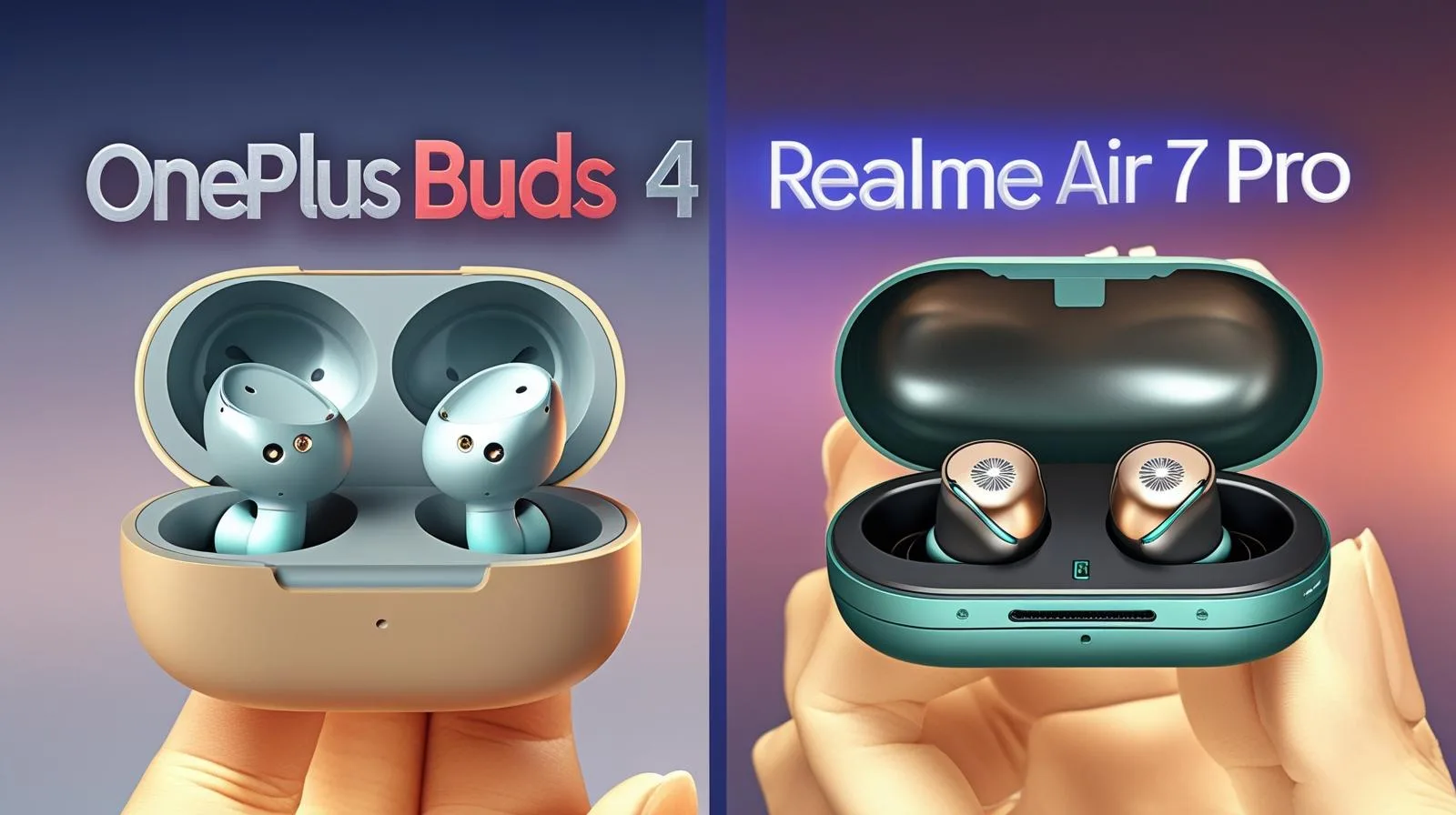
Hi everyone, it’s me, Fahad. These are two of the best wireless earbuds available for 5,000 to 6,000 rupees in India right now: the OnePlus Buds 4 and the Realme Buds Air 7 Pro.
The real question is: which one is right for you? If you look at the specs, you’ll see that everything from their driver setup to Audio codecs, connectivity, noise cancellation, and even battery life is nearly identical.
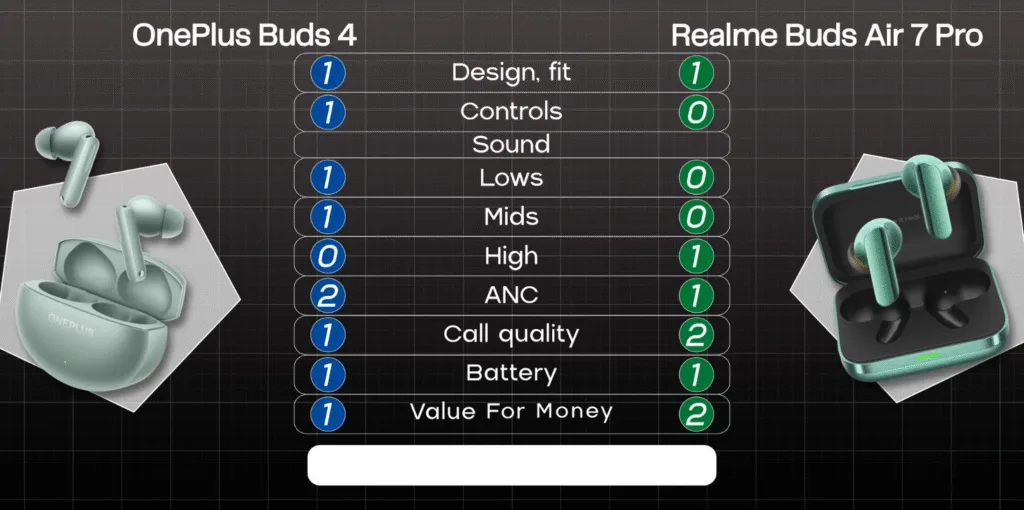
I’ll help you figure that out. Stick to the end of this post for the full breakdown. I will also assign points across different categories to determine a clear winner.
OnePlus Buds 4 vs Realme Air 7 Pro
Specs Comparison
Before we dive into the details, here is the raw data on how these two compare.
| Feature | OnePlus Buds 4 | Realme Buds Air 7 Pro |
| Drivers | 11mm Woofer + 6mm Tweeter | 11mm Woofer + 6mm Tweeter |
| Noise Cancellation | 55 dB (Adaptive ANC) | 53 dB (Deep Sea ANC) |
| Bluetooth Version | Bluetooth 5.4 | Bluetooth 5.4 |
| Codecs | LHDC 5.0, AAC, SBC | LHDC 5.0, AAC, SBC |
| Battery (ANC On) | Approx. 6 Hours (Earbuds) | Approx. 6.5 Hours (Earbuds) |
| Water Resistance | IP55 (Earbuds) | IP55 (Earbuds only) |
| Latency | 47ms | 45ms |
| Price | ~₹5,999 | ~₹5,499 |
Pros & Cons
Based on my testing, here is a quick summary of where each earbud wins and loses.
| OnePlus Buds 4 | Realme Buds Air 7 Pro | |
| The Good (Pros) | • Controls: Single tap play/pause & superior volume swipe. • Bass: Punchier, warmer bass (great for Hip-Hop/EDM). • ANC: Stronger cancellation of mid/high frequencies (voices). • Transparency: More natural sounding. | • Treble: Excellent clarity and sparkle in highs. • Mic Quality: Slightly better voice isolation in noisy/windy conditions. • Design: Premium metallic case & flat stems. • Value: Cheaper by ~₹500. |
| The Bad (Cons) | • Treble Detail: High notes can get lost in the bass. • Mic Quality: Can sound nasally/bassy in difficult conditions. • Case: Basic plastic shell feels less premium. | • Mids: Vocals feel slightly less open/detailed. • Controls: No single-tap play/pause; volume swipe is less responsive. • Transparency: Sounds slightly damp/congested. |
Also Read: Powerbeats Pro 2
Design and Fit

I want to start with the design. Interestingly, both OnePlus and Realme decided to copy each other’s last-gen earbuds. The OnePlus Buds 4 now comes in an egg-shaped case like Realme’s Buds Air 6 Pro, while the Air 7 Pro comes in a pill-shaped box case like last year’s OnePlus Buds 3.
I don’t have a problem with either of them. However, I have to give props to Realme for the metallic case, which feels much more Premium than the Buds 4’s bare plastic shell. It is even available with a leather-like finish, which is fantastic.
I also love how Realme redesigned the earbuds this time. They both still have stem-style earbuds like Apple’s AirPods, but the Air 7 Pro finally upgrades to a flat stem instead of a cylindrical one. I’ve been asking Realme for this for a long time since I found using touch controls on their older earbuds quite unintuitive due to the shape. That is no longer a problem.
I had no issues with the fit and comfort of either pair. They both sit very snugly in my ears with soft silicone ear tips that I can choose based on comfort. They are just as durable, too, with IP55 dust and water-resistant protection.
While Realme has a slight upper hand with its cold metal case, I am comfortable calling this round a tie.
Controls

The OnePlus Buds 4 are a clear winner when it comes to controls. This is not only because of the groove I mentioned before, but also because of two critical features missing on the Buds Air 7 Pro:
- Single Tap Control: It lets you play and pause music with a single tap, whereas I need to double-tap to stop playback on the Realme earbuds.
- Volume Swipe: The OnePlus Buds 4 swipe gesture to adjust volume is much more responsive than on Realme, especially when lowering the volume.
Active Noise Cancellation (ANC)
The OnePlus Buds 4 and the Realme Buds Air 7 Pro are two of the best budget earbuds I have tested for active noise cancellation.

They both use a three-microphone setup in each earbud. OnePlus claims it can eliminate up to 55 dB of surrounding noise, compared with 53 dB on Realme. That 2 dB difference might not seem like much, but decibels are logarithmic, not linear. The OnePlus 4’s ANC is technically around 58% stronger than Realme if you do the math. In my real-world testing, the OnePlus 4 got quieter than the Realme.
For example, low-frequency noises like AC units, city traffic, airplanes, or engine noise are eliminated just fine by both. However, the OnePlus Buds 4 surprised me with how effective they were at blocking mid- and high-frequency noise. Compared to the Realme Buds Air 7 Pro, the OnePlus cancels out sharper, challenging noises above 500 Hz noticeably better—especially human voices, birds chirping, vehicle sirens, and crying children.
I also found the Transparency Mode slightly more natural on the OnePlus 4. It did a better job convincing me I didn’t have earbuds on. In comparison, the Realme Buds Air 7 Pro sounds damp, congested, and less natural.
The one silver lining for Realme is that I can amplify human voices when Transparency Mode is on, focusing on a single speaker.
Call Quality
Next is call quality. Realme fans finally have something to cheer for: the Buds Air 7 Pro has slightly better microphone performance during calls.
I tested them under three scenarios: a quiet room, a noisy room (with ambient noise and running water), and directly in front of a table fan to simulate wind.
In almost every scenario, my voice sounded better on the Realme Buds Air 7 Pro. In contrast, I sounded bassy and nasally on the Buds 4 under challenging situations.
Battery Life
The battery life situation on both earbuds is practically the same. In my usage, I got roughly 6 hours of listening time on both with ANC turned on.
Also Read: Raycon Everyday Earbuds
Audio Quality
Let’s dig into the main course: Audio quality. A reminder that both the OnePlus Buds 4 and the Realme Buds Air 7 Pro have practically the same Audio setup. They both rock a dual-driver setup with an 11mm woofer for bass and a 6mm tweeter for treble, along with dual DACs.
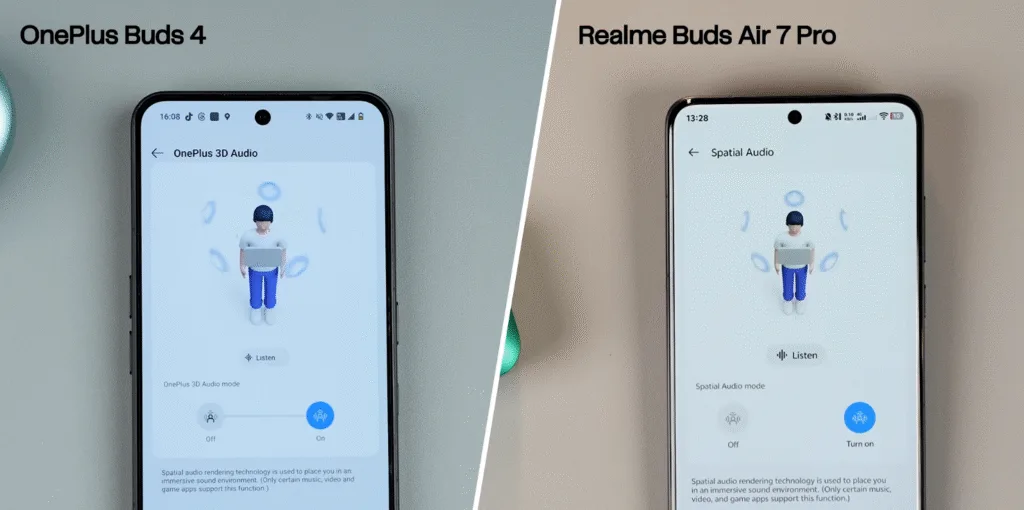
This setup can reduce crosstalk noise between drivers and improve tuning. They also support spatial Audio and high-res LHDC 5.0 codecs (up to 1 Mbps bitrate).
I will divide the Audio review into three sections to understand how they handle lows (bass), mids, and highs.
Bass and Mids: OnePlus Wins
In their default tuning, soundstage and imaging are mostly the same. However, I am more impressed with the warm, punchy bass response of the OnePlus Buds 4. If you listen to EDM, hip-hop, Bollywood, or similar bass-heavy genres, these OnePlus earbuds deliver that power much better.
For example, in Travis Scott’s “Fein,” the OnePlus Buds 4 conveyed the song’s energy much better. However, at high volumes, the sub-bass rumble can get slightly bloated.
Surprisingly, the Buds Air 7 Pro struggles a bit with mids. The timbre of vocals and wind instruments has a nicer tonal balance and sounds more open on the Buds 4.
Highs and Treble: Realme Wins
That said, the Buds Air 7 Pro’s treble response is among the best I have heard on budget earbuds. It does not come off as shouty or sibilant. The sparkle and clarity of high notes are preserved exactly how I like them.
In contrast, fine details often get lost in the thick cloud of bass on the OnePlus Buds 4. I noticed this clearly while listening to “The Catalyst” by Linkin Park. The Buds Air 7 Pro preserved the subtle hi-hat notes, whereas they were almost absent on the OnePlus.
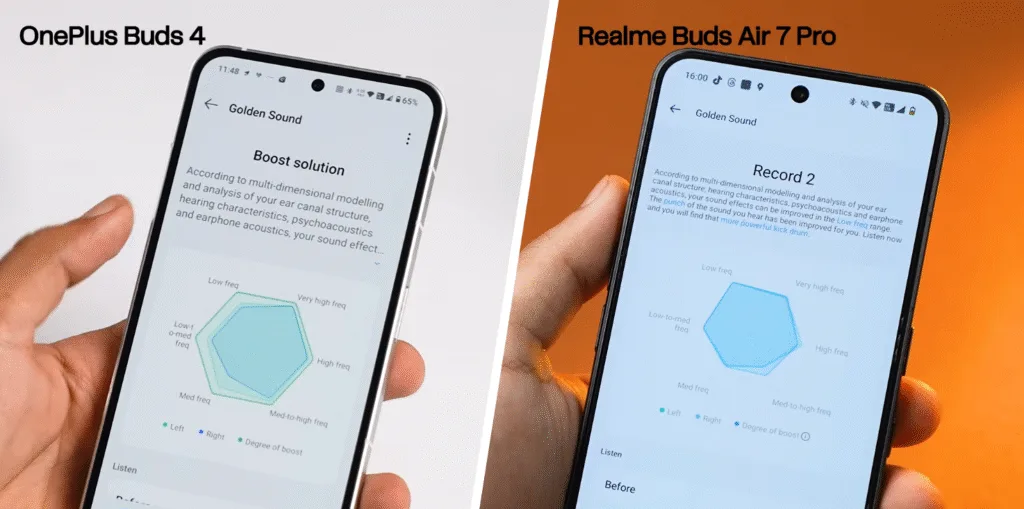
The good news is that I can tune both earbuds. I can choose from equalizer presets, create my own, or use “Golden Sound” to tune them to my hearing. While tuning made both sound more open, I still couldn’t get the open, sparkly trebles on the OnePlus Buds 4 that I found on the Realme.
Conclusion
Looking at the final score sheet, the OnePlus Buds 4 is our winner, leading by two points. This is despite the Realme Buds Air 7 Pro being a better value for money (costing 500 rupees less).
Which one should you buy?
- If you want the best noise cancellation, nicer bass, and easier controls, go with the OnePlus Buds 4.
- If you want slightly better call quality, mostly listen to classical or jazz (where bass isn’t as necessary), and enjoy the best bang for your buck, I highly recommend the Realme Buds Air 7 Pro.
FAQs
Which earbud is better for bass-heavy music like hip-hop or EDM?
The OnePlus Buds 4 is recommended for bass-heavy genres. It has a warmer and punchier bass response, delivering the power and energy better than the Realme Buds Air 7 Pro.
Which earbud offers better sound quality for treble, clarity, and detail?
The Realme Buds Air 7 Pro has one of the best treble responses for a budget earbud. The clarity of high notes and fine details is better preserved on the Realme Air 7 Pro, especially when compared to the OnePlus 4, where those subtle notes can get lost in the thick bass. This makes the Realme a better choice for genres like classical and jazz.
Which earbud has better call quality?
The Realme Buds Air 7 Pro has a slightly better microphone performance during calls. In noisy or difficult situations, your voice will sound a bit clearer from the Realme Buds Air 7 Pro compared to the OnePlus Buds 4, which can sometimes sound “bassy” or “nasally”.
What is the main difference in the controls and ease of use?
The OnePlus Buds 4 is the clear winner for controls. It features a single-tap for play/pause (Realme requires a double-tap) and a much more responsive swipe gesture for adjusting volume levels.
Which one is the better value for money?
While the OnePlus Buds 4 is the overall winner based on scoring, the Realme Buds Air 7 Pro is considered the better value for money, as it costs 500 rupees less.
That was all for this post. I hope you enjoyed it. Which one would you go for? Let me know in the comments!





[…] without becoming harsh. If you are debating the subtle sound differences, we conducted a full OnePlus Buds 4 vs Realme Air 7 Pro sound […]
[…] If you are confused checkout our compression of OnePlus Buds 4 vs Realme Air 7 Pro, with fewer pro […]
[…] While the OPPO sounds like a “musical instrument,” the Realme feels like a “flagship tool” that does everything a little bit more reliably. You might also wanna checkout OnePlus Buds 4 vs Realme Air 7 Pro. […]