

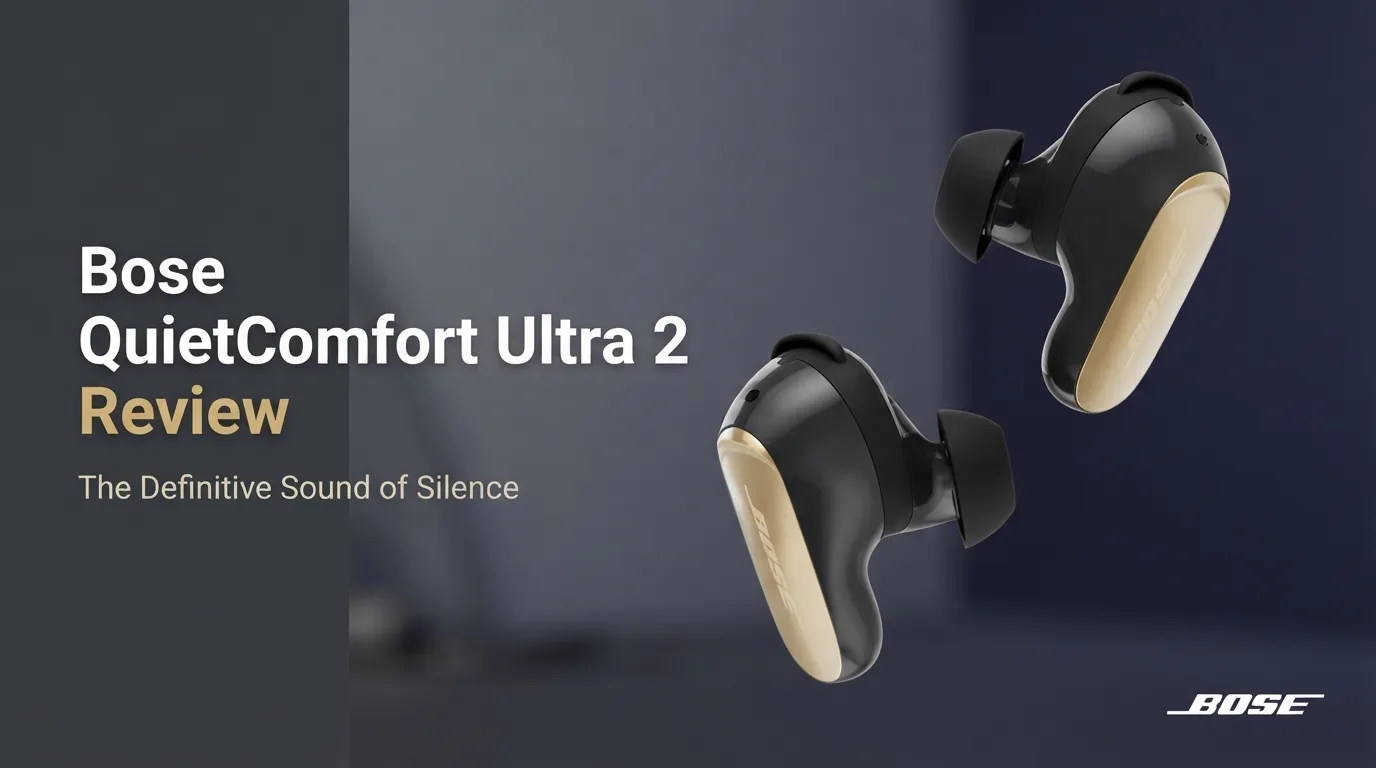
If you have ever stepped onto a screeching commuter train after a draining workday, you know the craving for one thing: pure, uninterrupted silence. That is the exact promise Bose has staked its reputation on for decades.
As part of my extensive testing for our annual guide to the Best Noise Cancelling Earbuds (2026), the Bose QuietComfort Ultra 2 was the first pair on my benchmark bench. Rather than relying on laboratory claims, I put them through a grueling 3-week real-world trial across 15 train commutes, four flights, dozens of noisy coffee shops, and sweaty gym workouts.
Here is my honest, unfiltered review of where the Bose QC Ultra 2 triumphs—and where it still annoys me.
Specifications & Battery Benchmark
| Feature | Specification / Detail |
| Driver Type | Custom Dynamic Driver |
| Codecs Supported | aptX Adaptive, aptX Lossless, AAC, SBC |
| Water Resistance | IPX4 (Sweat resistant) |
| Tested Battery Life (ANC On) | 5 hours, 52 minutes (Bose claims 6 hours) |
| Case Charges | 3 additional full charges (~24 hours total) |
| Multipoint Bluetooth | Yes (2 devices) |
How I Tested the QC Ultra 2
To simulate true noise extremes, I tested the QC Ultra 2 in four distinct zones:
- Subway & Train Commute (75–85 dB): Focused on low-frequency structural drone (30 Hz–150 Hz).
- Busy Espresso Bar (68–74 dB): Testing speech isolation and clattering dishes (mid-to-high frequencies).
- Flight Cabin Simulation: Continuous four-hour wear test assessing ear-canal cabin pressure and ear fatigue.
- Benchmarked Battery Test: Timed loop playing Apple Music at a calibrated 75 dB volume with ANC locked on.
1. Active Noise Cancellation: The Undisputed Benchmark
Let me be completely direct: nothing on the commercial market suppresses low-frequency drone as aggressively as the Bose QC Ultra 2.
On Day 3 of my testing, I stepped onto an older subway line known for its deafening mechanical rattle. The moment the earbuds sealed into my concha and the acoustic calibration tone sounded, the train’s deep roar simply evaporated. It did not just lower the volume; it felt as though someone pulled an acoustic blanket over reality.
Where the second-generation Ultra noticeably outperforms the original Ultra is in the mid-frequency spectrum. Voices of nearby commuters, which typically seep through most ANC filters, were pushed far back into an unintelligible whisper. In an espresso bar with a grinding coffee machine just 10 feet away, the noise was reduced to a soft, ignorable murmur.
While the Apple AirPods Pro 3 comes close in terms of casual office chatter, Bose remains the undisputed master of sustained mechanical rumblings.
NOISE REDUCTION SCORECARD (My Real-World Ratings):
- Low-End Drone (Engines, Subways): 10/10 (Flawless)
- Mid-Frequency Chatter (Voices, Cafes): 9.2/10 (Remarkable)
- High-Frequency Sharpness (Sirens, Clanking): 8.8/10 (Very Strong)
- Cabin Pressure Effect: 8.5/10 (Noticeable suction, but manageable)
2. Sound Quality & “Immersion Audio”
Historically, Bose delivered warm, consumer-safe audio that lacked the crisp micro-detail desired by audiophiles. With the Ultra 2, the tuning is distinctly more dynamic and alive.
- Bass: Deep and muscular. Listening to Hans Zimmer’s “Why So Serious?”, the 25 Hz sub-bass drop at the 3:20 mark delivered a physical, tactile chest resonance without muddying the upper frequencies.
- Midrange: Clear and present. Norah Jones’ vocals on “Don’t Know Why” felt intimate and textured, though male vocals can occasionally sound slightly warm.
- Treble: Smooth and roll-off-free. Cymbals have sparkle without that piercing, brittle edge that causes listener fatigue over 2-hour stretches. If you want maximum treble air, however, the planar tweeters in the Samsung Galaxy Buds Pro offer sharper separation.
- Bose Immersion Audio: Bose’s onboard spatial audio works with any device without proprietary codec lock-in. “Still” mode creates an impressively wide soundstage for live acoustic concerts and movies. However, “Motion” mode can sometimes introduce minor phase shifting during quick head turns.
3. Fit, Stability & All-Day Comfort
Bose uses a two-piece modular seal system: an oval ear tip combined with an outer silicone stability band that braces against the anti-helix of your ear.
This design remains the most secure, pressure-relieving fit in the earbud industry. During a 4-hour cross-country flight, I never felt the hot-spot soreness that traditional in-ear plugs produce. Even during 5K outdoor interval runs, the earbuds stayed completely anchored—no readjusting required.
4. The Daily Frustrations: Where Bose Still Lags
No product is flawless, and the QC Ultra 2 has several persistent quirks:
- The Touch Volume Slider: Adjusting volume requires swiping along a slender raised ridge on the stem. When adjusting my beanie or brushing hair out of my face, I accidentally triggered volume jumps multiple times.
- App Connection Hiccups: While the Bluetooth connection stayed rock-solid during playback, the Bose Music companion app took anywhere from 5 to 15 seconds to detect the buds when switching between my MacBook and phone.
- Microphone in Crowded Areas: While your voice comes through clearly in a quiet office, the beamforming mics tend to over-suppress ambient sound in gusty street winds, occasionally making your voice sound robotic.
The Final Verdict
If your priority is pure peace and quiet, the Bose QuietComfort Ultra 2 is worth every penny of its premium price tag. For frequent flyers, city commuters, and open-office workers, they remain the gold standard in noise isolation.


[…] consumer earbud in 2026:The Highs: The planar tweeter extracts acoustic micro-details that the Bose QuietComfort Ultra 2 and Apple simply gloss over. Cymbal hits on Miles Davis’ “So What”* decayed naturally […]