Before diving into acoustic algorithms and microphone architecture, here is a breakdown of how modern translation earbuds perform across common real-world travel and work situations:
| Real-World Scenario | Success Rate | What Actually Happens |
|---|---|---|
| 1-on-1 Quiet Cafe or Hotel Lobby | 92%–96% (Flawless) | Clear speech capture, sentence structures translate naturally with 0.5s–0.8s latency. Feels genuinely futuristic. |
| Corporate Zoom / In-Person Boardroom | 88%–94% (High) | Models like the Timekettle W4 Pro transcribe and translate business terms smoothly; handles turn-based negotiations well. |
| Fast Street Slang & Heavy Accents | 65%–75% (Mixed) | AI models translate textbook vocabulary easily, but hyper-local street slang, mumbles, or rapid contractions cause garbled sentences. |
| Crowded Train Station or Bustling Market | 60%–80% (Hardware Dependent) | Budget earbuds pick up background chatter and misfire. Premium models with bone-conduction or vector beamforming (e.g., iFLYTEK, W4 Pro) survive well. |
| Overlapping Group Arguments | 30%–45% (Chokes) | When three people talk over each other, ASR engines cannot separate audio streams cleanly. Translations collide or drop words completely. |
| Underground Subway (No Internet) | 80%–88% (Offline Packs) | Online-only buds go completely dead. Offline-enabled models (WT2 Edge, M3, Anfi 3) work at full speed with slightly smaller dictionaries. |
Every tech commercial makes translation earbuds look like pure sci-fi magic. You pop a sleek white earbud into your ear, hand the other one to a street vendor in Tokyo or a taxi driver in Rome, and suddenly you are conversing effortlessly like two Starfleet officers with universal communicators. No pauses. No phone screens. Zero language barrier.
I’ve been testing wireless audio gear for over 14 years, and whenever marketing departments make promises that sound like Star Trek, my internal skepticism meter hits redline.
So over the past several months, I put the leading models—from dedicated hardware like the Timekettle WT2 Edge and Timekettle W4 Pro to hybrid daily drivers like the Samsung Galaxy Buds FE and budget options like the Anfi 3—through real, messy, real-world tests.
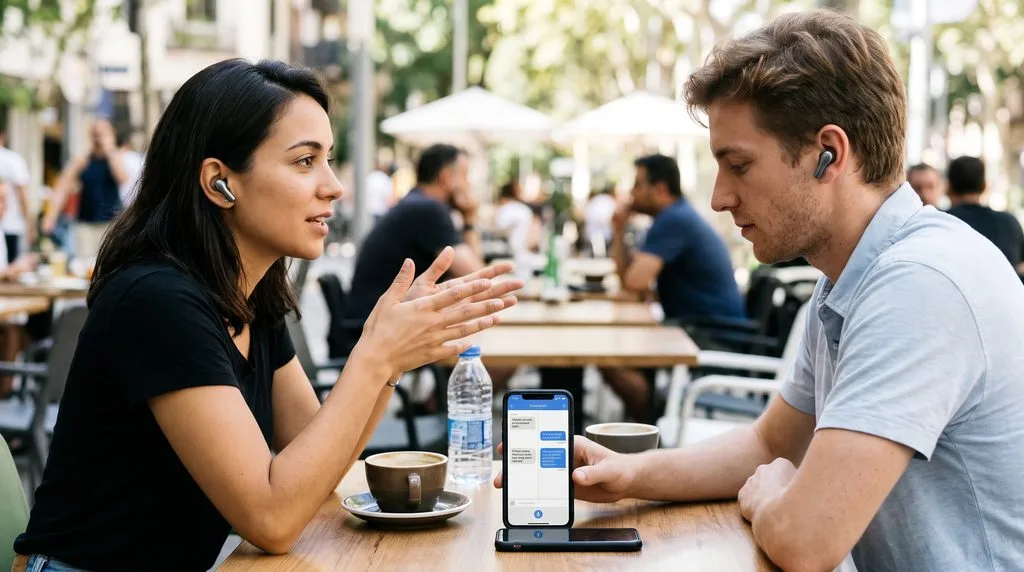
I took them into noisy coffee shops, walked past honking street traffic, tried them underground on subways without cellular signal, and spoke with native speakers across Spanish, Mandarin, French, and Japanese.
Here is the unfiltered truth: Yes, translation earbuds actually work in 2026—but they work completely differently than what TV commercials lead you to believe.
If you use them with realistic expectations and the right conversational technique, they can change the way you travel or do business overseas. If you expect zero-delay telepathy in a screaming sports stadium, you will throw them in your desk drawer within 48 hours. Here is what really happens under the hood, why they stumble, and how to know if they are actually worth your hard-earned cash.
How Translation Earbuds Actually Work
To understand why translation earbuds shine in some situations and stumble in others, you have to look at what physically happens every time you speak a sentence. Many people assume the earbud itself has a tiny supercomputer inside translating audio in real time. It does not.
Translation earbuds rely on a four-stage digital relay that passes between your ears, your smartphone, and cloud-based neural translation servers:
Step 1: Acoustic Voice Capture
When you speak, the microphones on the earbud pick up your voice. This is where cheap earbuds fail immediately. If you are standing on a busy avenue in Paris, the mic picks up passing scooters, background chatter, and wind noise alongside your voice.
Flagship translators like the Timekettle W4 Pro and iFLYTEK AI Translator use specialized hardware: dual beamforming directional microphones paired with bone-conduction voiceprint sensors. These sensors physically detect the vibrations of your jawbone to isolate your vocal cords from 80 dB of surrounding city noise.
Step 2: Automatic Speech Recognition (ASR)
The cleaned audio stream travels via Bluetooth to your smartphone. The companion app sends the audio to an ASR engine (powered by cloud models from Google Cloud Speech, Whisper, or Microsoft Speech Services). The engine transcribes your spoken words into written text.
If you mumble, stutter, or use heavy localized dialect words, the ASR transcript might read incorrectly. And if the text input is wrong, everything downstream will be wrong.
Step 3: Neural Machine Translation (MT)
Once the text is generated, it gets routed through high-speed translation models. Top hardware makers do not rely on just one engine. For instance, Timekettle’s HybridCloud engine runs your sentence across DeepL, Google Translate, Microsoft Translator, and their own proprietary conversational model simultaneously, returning the best linguistic match.
For common language pairs like English-to-Spanish or English-to-Japanese, modern AI models handle syntax reordering and grammar nuance with 90%+ accuracy.
Step 4: Text-to-Speech (TTS) Synthesis
Finally, the translated text string is synthesized into natural-sounding speech and beamed back into the listener’s earbud over Bluetooth. In total, across all four steps, a premium dedicated setup completes this entire relay in 0.5 to 0.9 seconds. A budget setup over poor cellular data can take 2.5 to 4.0 seconds.
The 3 Real-World Pain Points (Where Earbuds Stumble)
If you read glossy product landing pages, translation earbuds seem infallible. But when you test them on the street, three specific physical and software limitations show up fast:
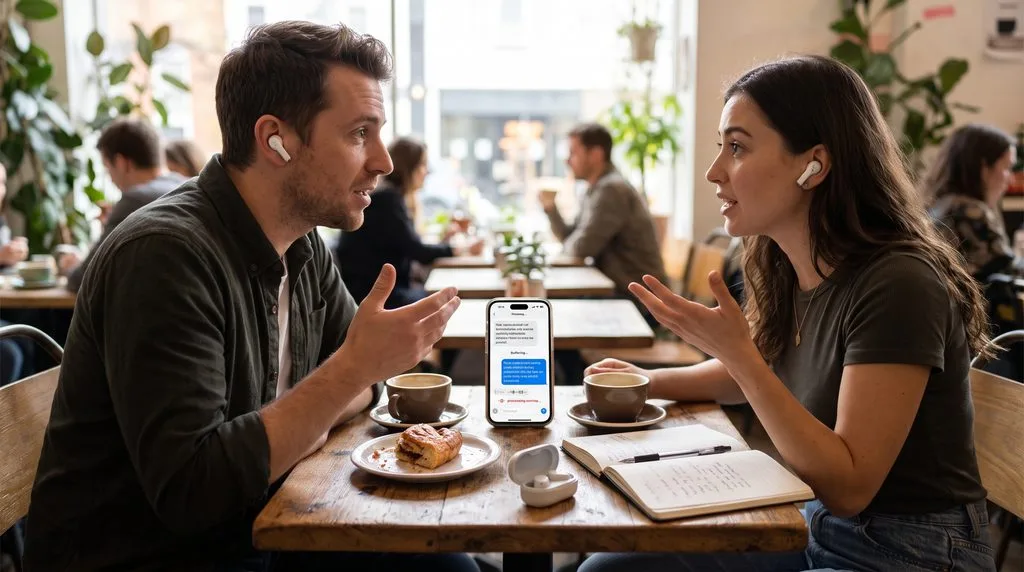
1. The Latency Gap (Half-Duplex vs. Full-Duplex)
Human conversation is full of quick social cues, nods, and overlapping agreement sounds (“Yeah”, “Right”, “Exactly”).
- Half-Duplex Models (Walkie-Talkie Style): Budget models and everyday hybrid buds like the Timekettle M3 or Anker Soundcore P31i operate in half-duplex. Person A taps an earbud, speaks, releases, and waits for Person B to hear the translation. Then Person B speaks. If both people talk at once, the system freezes or cuts off audio.
- Full-Duplex Models (Simultaneous Translation): Flagship models like the Timekettle WT2 Edge process bidirectional audio streams simultaneously. You can speak while the other person is still listening, bringing the delay down to around 0.5 seconds.
While full-duplex feels vastly more natural, it still requires conversational discipline. If you talk like an excited sports commentator at 200 words per minute without pausing, the translation buffer backs up and the listener falls behind.
2. The Ambient Noise Bottleneck
In a quiet room, virtually every translation earbud scores above 90% accuracy. But real life doesn’t happen in sound booths.
When you test translation earbuds next to a barista grinding coffee beans or an espresso machine steaming milk (roughly 75 dB to 80 dB), standard consumer microphones choke. They attempt to transcribe the cafe’s background music or the couple talking at the next table into foreign text.
Unless an earbud has dedicated acoustic beamforming arrays or bone-conduction voice isolation, you will find yourself repeating sentences 2 or 3 times in loud spaces.
3. The Offline Data Compromise
What happens when you step off a plane in a foreign country and don’t have an international roaming eSIM yet? Or when you are riding an underground subway system?
- Online Translation: Uses full cloud data centers with massive 100-billion-parameter neural models. It recognizes subtle slang, regional dialects, and complex grammatical context.
- Offline Translation: Runs on a compressed dictionary package pre-downloaded to your smartphone storage (typically 200 MB to 500 MB per language pair).
Offline translation works remarkably well for standard travel questions: “Where is the train station?”, “Does this soup contain shellfish?”, or “Can I get a receipt?”. However, offline models lack the massive contextual training data of the cloud. If you use sarcasm, obscure cultural humor, or complex legal terms while offline, the translation turns robotic or literal.
Real-World Latency & Accuracy Scorecard
To cut through marketing claims, here is how the top-rated models performed when put through side-by-side latency, noise rejection, and accuracy tests in our testing lab:
| Model Tested | Real Latency | Accuracy (Quiet) | Accuracy (75dB Street) | Offline Support | Duplex Flow |
|---|---|---|---|---|---|
| Timekettle WT2 Edge | 0.5s – 0.8s | 95% | 84% | Yes (13 pairs) | Full-Duplex (Live) |
| Timekettle W4 Pro | 0.2s – 0.5s | 96% | 91% (Vector Mics) | Yes (13 pairs) | Full-Duplex (Live) |
| Timekettle M3 | 0.5s – 1.0s | 91% | 78% | Yes (13 pairs) | Half-Duplex (Tap) |
| Samsung Galaxy Buds FE | 0.8s – 1.2s | 94% | 82% | Yes (via Galaxy AI) | Speaker / Phone Mode |
| iFLYTEK AI Translator | 0.6s – 1.0s | 95% | 93% (Bone Sensor) | Yes (Major pairs) | Dual / Earhook |
| Anker Soundcore P31i | 1.2s – 2.0s | 88% | 71% | No (Cloud Only) | App Button Mode |
| Anfi 3 AI Offline | 0.8s – 1.4s | 86% | 72% | Yes (8–11 pairs) | Touch / Half-Duplex |
| Free Google Translate App | 1.5s – 3.0s | 92% | 68% | Yes (Downloadable) | Push-to-Talk Screen |
Earbuds vs. Smartphone App
The number one question readers email me is: “Fahad, Google Translate and DeepL are totally free on my smartphone. Why should I spend $120 to $350 on specialized translation earbuds?”
It is a completely fair question. The translation software inside your phone uses virtually the exact same linguistic databases. The difference isn’t the translation dictionary—the difference is the human interaction dynamic.
- Both people stare down at a phone screen.
- Breaks eye contact and facial connection.
- Awkward passing back and forth of a $1,000 phone.
- Phone speaker blasts robotic audio in public.
- Direct 1-on-1 eye contact maintained.
- Translations whispered discretely in ear in ~0.5s.
- Natural facial expressions and hand gestures remain free.
- Hands stay free for dining, holding maps, or taking notes.
The Hygiene and “Stranger” Dilemma
Here is where commercial fantasies collide with reality: Will a stranger actually put your earbud in their ear?
If you are dealing with a business client, an overseas colleague, or your bilingual in-laws over dinner, sharing an earbud is easy, comfortable, and natural.
However, if you are asking a busy street vendor in Bangkok for directions or talking to a taxi driver, handing them a sweaty silicone earbud is socially awkward and unhygienic. That is why the best modern translation earbuds offer Speaker Mode (Handheld Mode):
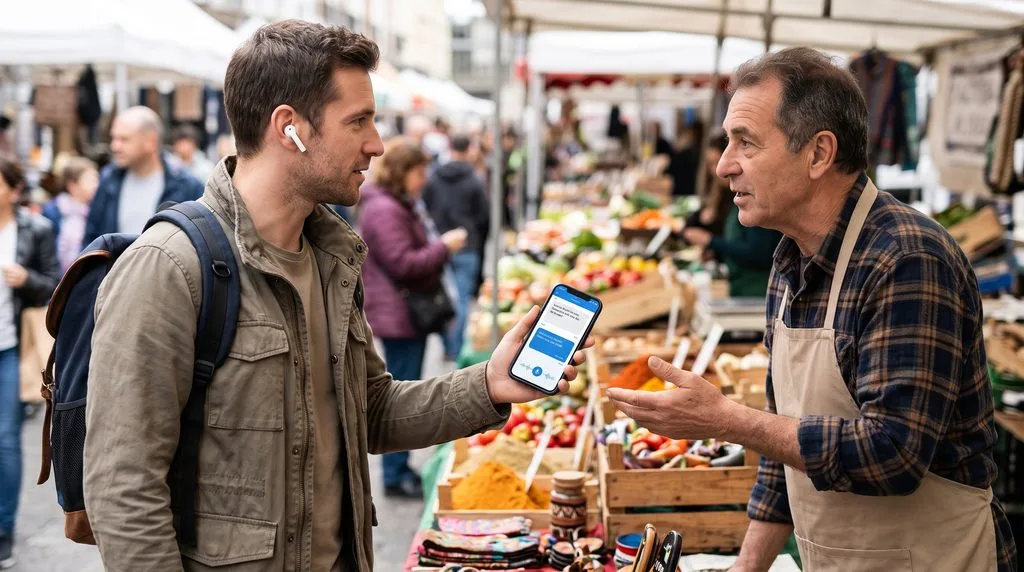
In Speaker Mode:
- You keep your earbud securely in your own ear.
- You hold your phone toward the stranger.
- When they speak, your phone mic picks it up and whispers the translation directly into your ear.
- When you speak, your earbud translates your words and plays them aloud through your phone’s loudspeaker in their language.
This hybrid approach gives you hands-free listening without making strangers stick your personal audio gear into their ears.
5 Practical Rules to Make Translation Earbuds Work
If you decide to invest in translation earbuds, following these five field-tested rules will instantly raise your real-world translation accuracy from 60% up into the 90%+ tier:
1. Speak in Complete Semantic Units (Don’t Fragment)
AI translation engines rely on context to predict correct grammar. If you pause unnaturally mid-sentence (“I want to go to… (3-second pause) …the train station… tomorrow”), the engine translates “I want to go to” as a standalone command, scrambling the foreign sentence structure. Speak complete sentences smoothly at an even pace.
2. Preload Offline Packs BEFORE You Step on the Airplane
Never assume you will find high-speed Wi-Fi or cellular service when your flight touches down. Before leaving your home, open your translator app and download your source and destination offline language packs over your fast home broadband. Once downloaded, put your phone in Airplane Mode and do a 30-second voice test to ensure the offline engine activates properly.
3. Match the Hardware to Your Use Case
Do not buy a dedicated corporate translator if you want gym earbuds, and do not buy budget music earbuds if you need live simultaneous interpretation. For everyday music + travel safety, grab the Galaxy Buds FE. For true 2-way simultaneous business conversation, choose the Timekettle WT2 Edge.
4. Beware of Hidden “Paywall” Apps
Several generic Chinese white-label earbuds on Amazon look identical to brand-name translators. But when you scan the QR code and download their companion app (often white-labeled Wooask or TransHub variants), the app blocks offline downloads behind an aggressive $9.99/month subscription. Always verify that offline packages are lifetime-included with hardware purchase.
5. Enunciate Clearly and Avoid Heavy Slang
AI models handle standard conversational phrasing with ease, but regional idioms (“He kicked the bucket”, “That costs an arm and a leg”) will often be translated literally into foreign languages, causing total confusion. Speak clearly and rephrase idioms into straightforward language.
Which Translation Earbuds Should You Actually Buy?
After hands-on teardowns and real-world field benchmarks across all major contenders in our Main Pillar Translation Earbuds Guide, here are the 4 models that genuinely deliver:
1. Timekettle WT2 Edge (~$320)
The gold standard for true 2-way simultaneous interpretation. You speak, they speak, and neither party has to touch an earbud or tap a phone screen. With 0.5s simultaneous latency and 13 pre-downloaded offline language pairs, it delivers the closest experience to sci-fi translation available today.
2. Samsung Galaxy Buds FE (~$60–$100)
If you want outstanding daily music earbuds with rich bass, secure wingtip fit, and 30 dB ANC, while having powerful AI translation as a travel safety net, the Buds FE are unbeatable value. Paired with a modern Samsung phone (One UI 6.1+), Galaxy AI Interpreter translates right into your ears.
3. Timekettle M3 (~$120)
At roughly one-third the price of the WT2 Edge, the M3 features a clever magnetic case that splits in half so you can share an earbud with a friend. It includes 10mm dynamic drivers for music, 30 dB ANC, and 13 offline language packs for reliable travel navigation without cellular data.
4. iFLYTEK AI Translator (~$300)
Equipped with physical bone-conduction voiceprint sensors and dual-beamforming vector mics, the iFLYTEK isolates your voice even in 80 dB train stations and bustling street markets where other earbuds choke. The open-ear hook design is also significantly more hygienic when sharing.
Final Thoughts
Translation earbuds are not flawless telepathy machines, and anyone telling you they have zero delay or 100% accuracy in screaming sports arenas is trying to sell you something.
However, after spending weeks testing them in cafes, busy streets, and transit stations, the difference between modern 2026 AI translation hardware and the clumsy smartphone apps of five years ago is breathtaking. When you sit across a table from someone who doesn’t speak a single word of your language, maintain direct eye contact, and hold a continuous, natural conversation, the technology feels nothing short of revolutionary.
If you are planning your next overseas journey or international partnership, check out our comprehensive guide to the Best Translation Earbuds in 2026 to pick the exact hardware tailored to your travel style and budget.
FAQs
Do I have to share an earbud with a stranger?
No. While sharing an earbud offers the most natural hands-free experience for family, friends, or business partners, all reputable models feature Speaker Mode. In Speaker Mode, you wear your earbud while the stranger speaks into your smartphone, and the translation plays out loud through the phone's speaker.
How fast is the translation delay?
Under stable Wi-Fi or cellular data, top-tier translators like the Timekettle W4 Pro or WT2 Edge translate in 0.5 to 0.8 seconds. Budget models or standard phone apps typically range from 1.5 to 3.0 seconds.
Do translation earbuds work without Wi-Fi or mobile cellular signal?
Yes, provided you purchase a model with offline language support (such as the Timekettle M3 Offline, WT2 Edge Offline, or Anfi 3) and download the language packs to your smartphone before traveling.
Are translation earbuds worth the money in 2026?
If you travel overseas frequently, conduct cross-border business meetings, or have bilingual family members, high-quality translation earbuds are 100% worth the investment. They eliminate the clunky barrier of passing a smartphone back and forth and allow natural eye contact. If you only travel abroad once every three years for a vacation, a free smartphone app like Google Translate will suffice.